Edinburgh · Old Town
The Royal Mile and its closes
A short winter walk downhill, with narrow closes dropping away on either side and the route continuing from the castle to Holyrood.
- Part of town
- Old Town
- Give it
- half a day
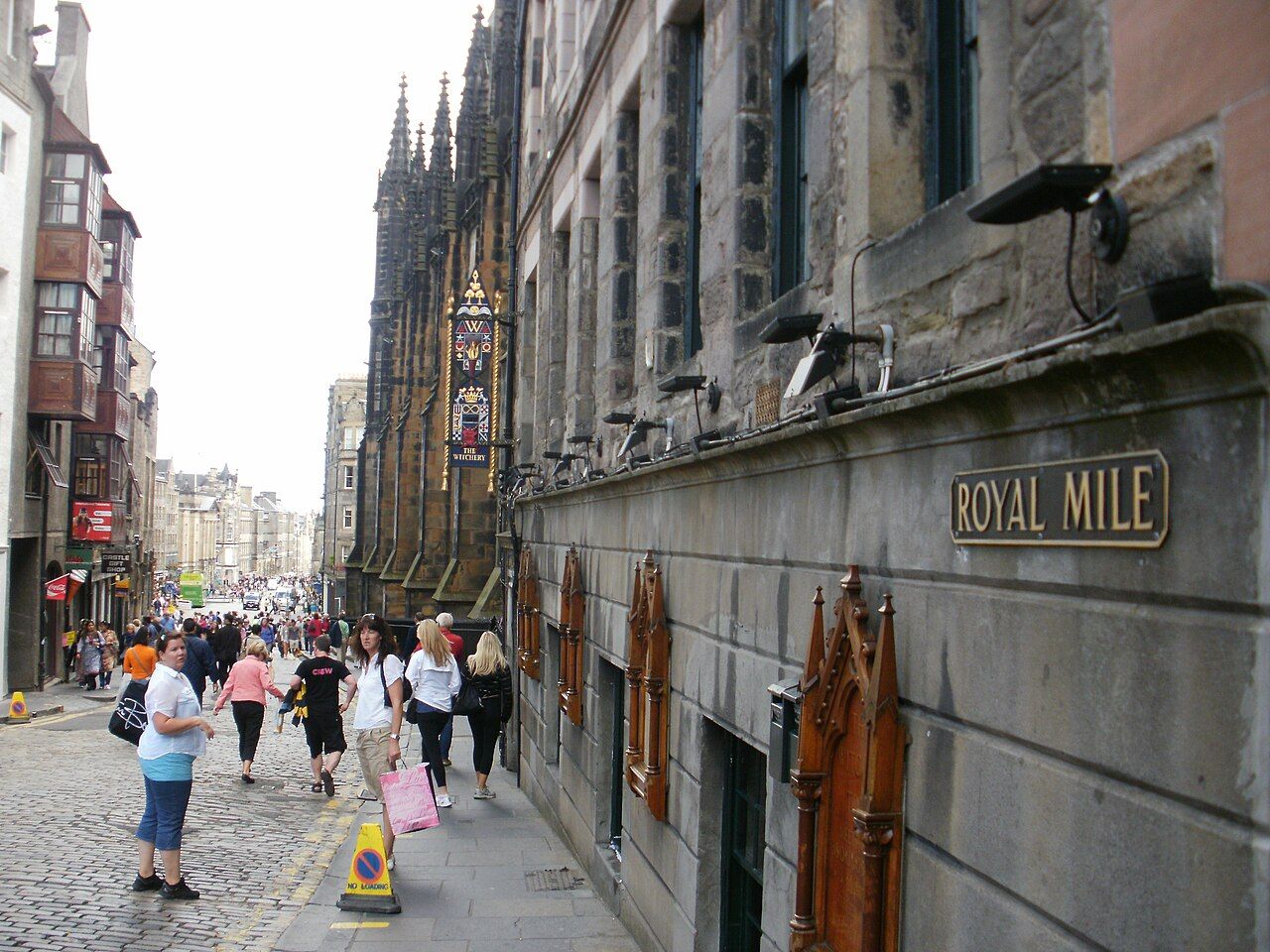
In late December, the day gives us less than seven hours of daylight. By mid-afternoon, the street lamps are lit. We start at Edinburgh Castle and take the Royal Mile downhill toward the Palace of Holyroodhouse, with the short day setting the pace: there is a long route to cover, and plenty to notice along the way.
- Route: Edinburgh Castle to the Palace of Holyroodhouse
- Length: about one Scots mile, roughly 1.8 km
- Time: half a day
- District: Old Town
1. The route and its side alleys
The name suggests a simple measure, but the Royal Mile is about one Scots mile long, roughly 1.8 km. It runs downhill from the castle to Holyrood. The route is short enough to follow on foot, but the closes give it another dimension. They are narrow alleys that drop steeply off the Royal Mile to either side.
We keep to the main way for a stretch, then look down one of the closes. Each is a sharp change of direction and level: the Royal Mile continues forward while the alley falls away. Their narrow openings keep interrupting the straight downhill line, and we find ourselves looking into them before carrying on. They are part of the route, not a separate destination to save for another time.
The closes are not side streets so much as steep departures from the Royal Mile.

The closes are not side streets so much as steep departures from the Royal Mile.
Lady Stair's Close leads to the Writers' Museum, about Burns, Scott and Stevenson. The names give this close a clear destination, but the shift in scale is what stays with us: a narrow alley opening from the larger route, with a museum at its end. We carry on downhill, taking the closes as small interruptions in the walk rather than trying to fit them into a single view.
There is no need to turn every close into a stop. Some are better understood as a pattern along the route: narrow openings, steep drops, and the same return to the Royal Mile. We make our way between them, with the next part of the walk always lower than the last.
The shift is not only in direction. From the main street, each close presents a narrow opening and a steep descent; from within one, the Royal Mile is the place to return to. That back-and-forth is part of the walk's shape, and it keeps the route from feeling like one uninterrupted slope.
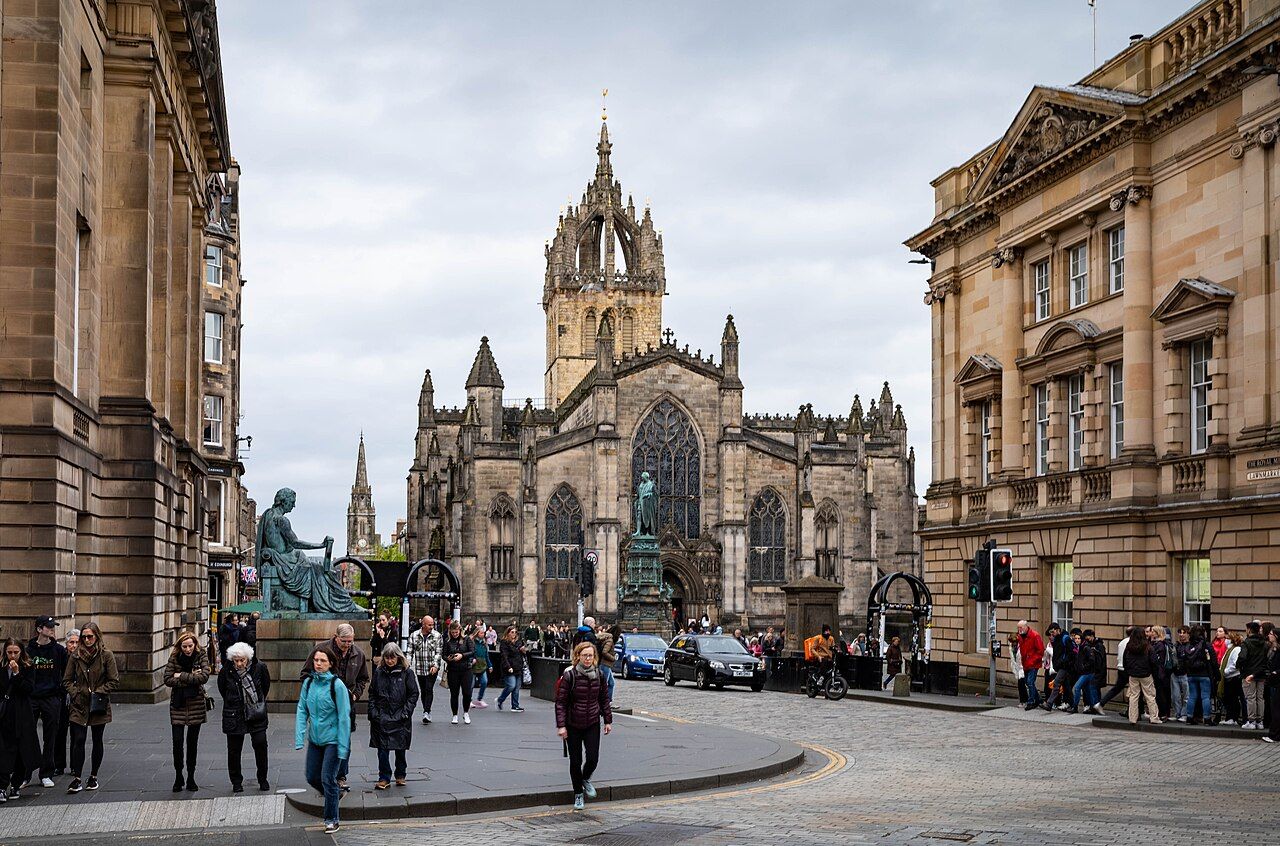
St Giles' Cathedral has a crown-shaped steeple over the High Street. It gives this stretch a clear point of reference above the route. The street lamps are already part of the scene by mid-afternoon in late December, while the walk still has distance to go.
2. Below the street, and on to Holyrood
One of the closes has a different story from the others. Mary King's Close was buried under the City Chambers in the 18th century and can be visited underground. The words “under the City Chambers” change how we picture the street above it. Here, the route does not only descend through alleys; it also passes over a place that was buried below the city.

We return to the surface and continue down the Royal Mile. The Canongate Kirkyard is the burial place of the economist Adam Smith. It gives this stretch another point of connection to a person whose name is familiar from beyond Edinburgh. The walk moves from the city’s public route to a kirkyard, then back again.
At the foot of the Royal Mile stands the Scottish Parliament building. It opened in 2004 and was designed by the Catalan architect Enric Miralles. Its presence marks the end of the downhill route, a modern civic building at the lower end of a street that has carried us past the cathedral, closes, museum and kirkyard.
The Old and New Towns of Edinburgh were listed by UNESCO in 1995. Along this walk, the listing feels less like an abstract label than a way to think about the route as a whole: the Royal Mile and its closes, the buildings and places beside it, and the layers below its surface. We have followed one line downhill, but it has repeatedly opened into smaller paths and stories.
At the lower end, the route points toward the volcano at the bottom of the hill. We leave that for another walk and continue toward Holyrood. On this short winter day, the lamps are lit and the closes have gone quiet in our retelling. We take the last stretch together, with the street still leading downhill.
Next on our list: Leith, Down by the Shore